



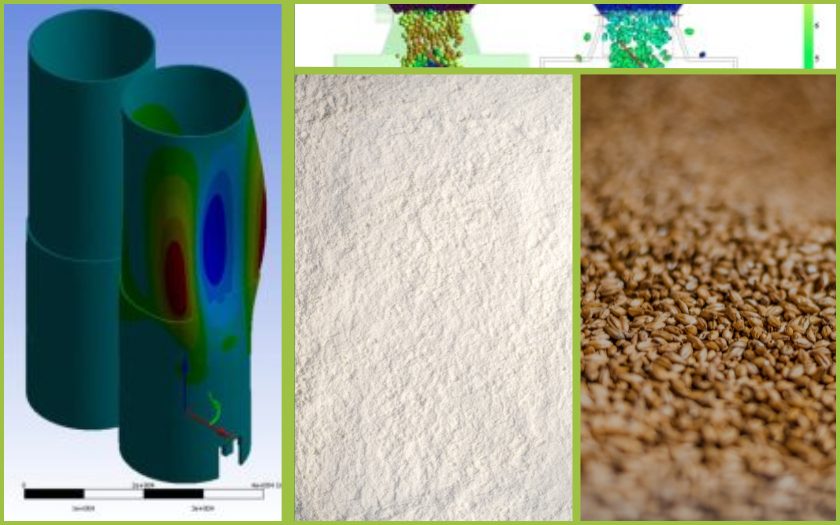
Analytical modeling establishes a framework for engineers to predict and analyze how materials and systems behave under a range of conditions, from varying loads and flow regimes to changes in temperature, moisture, and material composition. By simulating bulk solid flow, storage, and discharge processes through mathematical and computational models, it allows engineers to predict flow behavior, evaluate stress and pressure profiles, and design handling systems that prevent issues such as arching, ratholing, and segregation.
Powders and grains present distinct challenges in bulk solids engineering, as their flow and stress behaviors are complex and often difficult to predict. Analytical modeling can help in understanding such behavior and improve system performance. Two main modeling approaches are used to analyze bulk material behavior: continuum modeling and Discrete Element Method (DEM) modeling. Each of these techniques offers a unique perspective on material behavior, contributing to a complete understanding of bulk material flow.
Continuum Modeling: Replicating Real-World System Behavior
Definition
Continuum modeling represents materials as continuous media in which properties such as stress, strain, and velocity change smoothly throughout the domain. Instead of tracking individual particles, it focuses on how a material collectively deforms and transmits forces under load.
Core Principles
When materials deform or flow, continuum modeling uses the laws of mass, momentum, and energy conservation to describe their behaviors as continuous systems. These principles are expressed through partial differential equations that govern stress, strain, and motion. They are paired with constitutive models such as elasticity, plasticity, or viscosity to define how materials respond under different loads, stresses and flow conditions. Together, they provide the foundation for continuum mechanics and computational techniques like Finite Element Analysis (FEA) and Computational Fluid Dynamics (CFD).
The Role of Material Flowability Testing
Continuum modeling for bulk solids relies on experimentally measured material properties obtained through flowability testing. Shear testing provides key parameters such as yield strength, internal frictional angle, wall friction, and bulk density, which establish the constitutive relationships that describe how a material will deform and flow under load. These measured properties provide the governing parameters for hopper, bin, and feeder design within a continuum modeling framework. Because the model depends directly on such inputs, calibration to actual material flow behavior is vital. When the material properties accurately reflect measured flow characteristics, the model can predict stress distributions, discharge rates, and flow patterns with a high degree of reliability. If they do not, the results lose validity and cannot be utilized to support sound design decisions.
Applications
- Solid and fluid mechanics simulations
- Heat transfer and thermal analysis
- Hopper and bin flow behavior
- Large-scale deformation studies
Is It The Right Approach?
Continuum modeling should be used when the goal is to understand global flow or stress behavior rather than particle-scale detail. It is ideal for applications where a material can be approximated as a continuous field.
Discrete Element Method (DEM) Modeling: Simulating Particle Interactions in Detail
Definition
DEM is a computational modeling technique utilized to simulate the behavior of granular and particulate materials. It represents a system as a collection of individual particles whose motions and interactions are calculated over time using Newton’s laws of motion and defined contact-force models.
Core Principles
Algorithms such as contact detection and time integration are implemented in DEM to track particle motion and calculate interaction forces. Contact detection determines when particles interact, while force models compute normal and tangential forces based on overlap, friction, and damping. The system evolves through explicit time integration, resolving particle positions and velocities to capture realistic motion and interaction behavior.
The Role of Material Flowability Testing
DEM simulations also rely on experimentally measured material properties obtained through flowability testing. Characteristics like particle density, friction coefficients, cohesion, restitution, and stiffness must be defined using laboratory data and, where necessary, adjusted to reflect observed bulk behavior. Since DEM calculates particle interactions directly, the accuracy of the defined material’s properties and contact parameters strongly influences predicted flow patterns, stress transmission, and discharge behavior. Calibration against measured performance ensures that the simulated outputs correspond to the material’s observed bulk response under operating conditions.
Applications
- Powder and granular flow prediction
- Rock and soil mechanics simulations, particularly related to transfer chutes
- Mixing, blending, and segregation processes
Is It The Right Approach?
DEM is ideal for analyzing the detailed mechanics of particle motion and for visualizing flow patterns that are difficult to capture experimentally. Such a method is often used for validating and refining physical or analytical models.
Integrating Continuum and DEM Methods in Analytical Modeling
Analytical modeling combines continuum and DEM approaches to link micro-scale interactions with system-scale performance:
- Continuum modeling: captures bulk flow, stress, and deformation.
- DEM: connects particle motion to measurable bulk properties.
Insights from each technique are integrated within analytical modeling to enhance predictive accuracy and strengthen the connection between theoretical modeling and real material behavior. This allows engineers to translate particle- and system-scale findings into practical design improvements for bulk solid handling.
Undertake Analytical Modeling With Jenike & Johanson
Analytical modeling provides a structured basis for predicting and optimizing material behavior across different scales of bulk solid flow. Continuum modeling captures large-scale responses and DEM links particle mechanics with real-world performance. These analytical modeling methods form a structured framework for designing, validating, and improving bulk solid handling systems.
At Jenike & Johanson, analytical modeling drives how we solve complex flow challenges. It allows us to understand and explain problems that are occurring. Combining this with our sixty years of experience in solving real world, industrial problems, we can quickly determine how best to modify designs to eliminate problems. With the integration of analytical insight, physical testing, and discrete simulations, we help clients design systems that perform reliably and efficiently. Contact us to learn how our analytical modeling can improve material flow, optimize equipment design, and ensure process performance.