



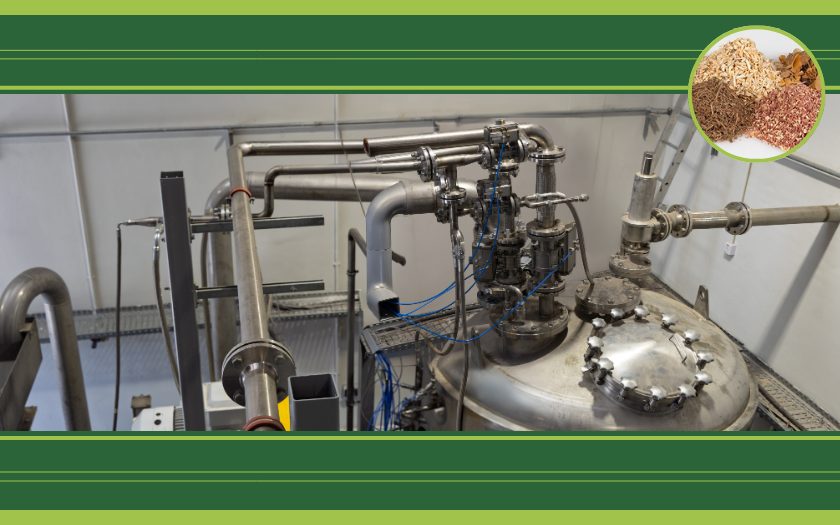
Feeding biomass or MSW into a high-pressure reactor is a critical operation in a variety of thermochemical conversion processes, from gasification and pyrolysis to hydrothermal liquefaction. What appears as a routine transfer of solids is, in fact, the point at which biomass or MSW must transition across a steep pressure boundary and maintain stable flow. These reactors depend on elevated pressures to drive their chemistry, so small variations in moisture, particle sizes, or fines content can disrupt biomass flow through the feed system. Consequently, handling biomass flow into high-pressure reactors calls for feeding technologies engineered to manage both the pressure boundary and the variability of the feed.
Why Biomass and MSW Challenges High-Pressure Feeding Systems
Biomass, as well as MSW, behave differently from most industrial solids. They arrive with variations in moisture, particle geometry, and fines content, all of which influence how they flow and respond to pressure. These factors become more pronounced as the material enters pressurized equipment. The result is greater compaction, higher cohesion, and an elevated risk of flow stoppages.
Engineers frequently encounter issues when trying to maintain reliable biomass flow, such as:
- Consolidation under pressure, which increases resistance to movement.
- Spring-back effects when pressure is released, generating undesirable and unpredictable expansion.
- Bridging and ratholing in hoppers, silos, or intermediate chambers.
- Dust generation, which introduces additional safety considerations for enclosed systems including explosion risk and equipment contamination.
These behaviors underline the need for equipment designed not only to move solids, but to manage the way biomass changes during pressurization.
How Engineers Handle Biomass/MSW Flow into High-Pressure Reactors
Managing biomass/MSW feeding under pressure requires an approach grounded in material science as well as mechanical design. Engineers handle biomass/MSW flow into high-pressure reactors by using:
- Staged pressurization methods- use lock-hoppers or similar vessels to isolate solids at atmospheric pressure, then raise it to reactor pressure in controlled increments so solids can move forward without gas backflow.
- Mechanical feeding devices- employ screws, rams, or plug-forming mechanisms to physically force solids across the pressure boundary in a continuous manner.
- Hopper geometries designed for mass flow- shape the storage and dosing hoppers so entire material content moves uniformly toward the feeder, avoiding stagnant zones, ratholes, and irregular discharge that destabilize pressurized feeding.
- Flow-conditioning features- apply agitation, vibration, or venting paths to limit consolidation as the material is confined and pressurized, helping maintain a predictable flow.
- Dust- and pressure-control measures- including inerting, explosion protection, and sealed containment to control combustible dust and prevent the release of pressurized gas into upstream equipment.
By configuring the feeding system around the feedstocks’ specific flow properties, engineers can deliver a stable and controllable feed to the reactor.
Common Feeding Approaches for High-Pressure Feed Systems
There are a range of technologies designed to commonly manage biomass/MSW flow into high-pressure reactors. Each employs a distinct strategy for handling the pressure boundary and variable nature of the feed and have their own merits and demerits.
Conventional Lock-Hopper Systems
Conventional lock-hoppers move biomass from ambient conditions to high reactor pressure through staged filling, sealing, pressurizing, and discharge. Their strong pressure isolation makes them a common choice in high-pressure biomass gasification systems for materials such as coal and petcoke. However, when working with biomass, conventional lock hoppers often experience plugging and material jamming issues.
Pneumatic or Entrained-Flow Injection
Pneumatic or entrained-flow injection relies on a pressurized carrier gas to entrain and propel fine biomass particles through an injection line and into the high-pressure reactor. The resulting gas-solid jet supports flow at high capacities, when the feedstock material is a fine powder that is also free flowing and disperses well in the gas phase. It is not suitable for common biomass or MSW feedstocks that contain long particles.
Mechanical Screw and Plug Feeders
Mechanical feeders rely on a screw or plug mechanism to push biomass through a pressure-rated housing. They require little or no carrier gas. For feedstocks that behave consistently under forced mechanical conveying, these feeders can work well. This can apply to pelletized or other homogeneous feedstocks. With milled biomass and MSW feedstocks, if the pressure is high, such feeders can cause the feedstock to form non-uniform plugs, which can develop cracks and result in pressure blowback. Should much higher pressures be used to improve plug formation, it can jam the material within the feeder, whereas biomasses with high ash or silica content can cause mechanical systems to wear prematurely, generating dangerous pressure blow-backs in the process.
Slurry and Wet-Feed Systems
Some systems introduce biomass as a slurry, enabling pumped biomass flow into the high-pressure reactor. This simplifies the pressure transition and aligns naturally with hydrothermal processes that operate with aqueous phases. However, it can severely limit the choice of allowable reactions and process conditions.
When Traditional Biomass/MSW Feeding Systems Struggle
Modern bioenergy and waste-to-fuel processes often rely on feedstocks that push conventional high-pressure feeding equipment to its limits. Agricultural residues, MSW fractions, and fines-rich materials can consolidate aggressively, resist uniform movement, and introduce variable moisture conditions. The result is often a pattern of:
- Erratic feeding
- Chamber overfilling or plugging
- Difficulty maintaining a pressure seal
- Inconsistent mass flow into the reactor.
While some plants attempt to overcome these issues through densification, this increases operating costs and energy demands. A more effective solution is to adopt a feeding technology specifically designed to handle the behavior of low bulk density and highly variable biomass.
Jen-Zero™ as a Novel Solution
Jen-Zero™ is a patent-pending technology developed by Jenike & Johanson to overcome the limitations associated with feeding biomass and MSW into high pressure reactors. It was specifically developed to handle low-density, highly variable biomass that traditional high-pressure feeding systems struggle to move reliably. It uses a specialized pressurization sequence and chamber configuration that limits consolidation, controls expansion, and supports a stable discharge into a high-pressure reactor. With a unique diverging pressurization chamber-based design and continuous screw conveyors, Jen-Zero™ reduces biomass consolidation and springback to ensure stable, continuous feed into high-pressure reactors. Such performance is particularly valuable in gasification, waste-to-energy, and advanced biofuel applications, where reliable feed is essential for consistent reactor operation and overall plant uptime.
For more information about Jen-Zero™ or to discuss how Jenike & Johanson can help improve biomass flow into a high-pressure reactor, speak with our specialists today.