



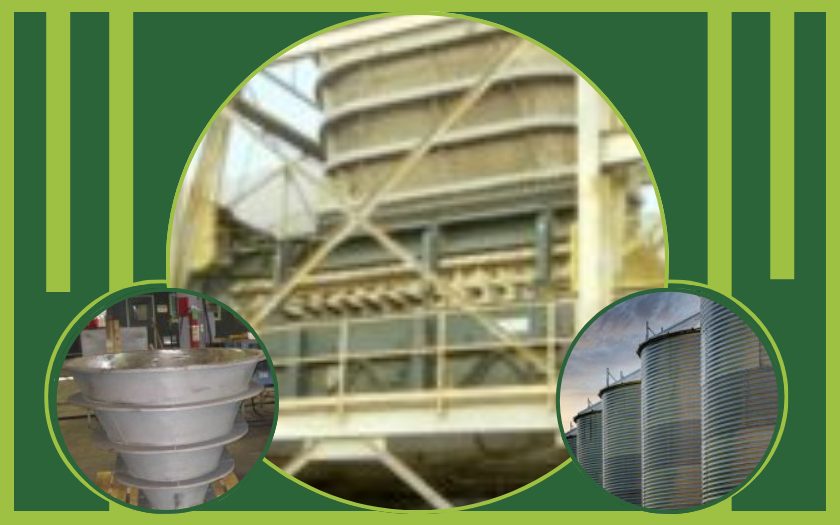
A well-designed end-to-end bulk material storage and feeding system allows bulk solids to move smoothly from storage through the feeder without interruption to feed the downstream process at the desired rate. Three critical components determine its effectiveness: the hopper or silo that stores the material, the outlet, and the feeder that regulates the rate material enters the next process. If these components are designed independently and disregard material flow characteristics, flow issues can occur such as plugging, ratholing, arching, or erratic flow. By addressing storage, discharge, and feeding together, engineers can develop end-to-end bulk material storage and feeding systems that establish the right flow regime and ensure reliable performance throughout the entire process.
Characterizing the Conveyed Material
The behavior of bulk solids varies widely with particle size, moisture, and time at rest. Free-flowing granular material may empty easily, while a fine cohesive powder can bridge over an outlet. Before any end-to-end bulk material storage and feeding systems can be properly designed, engineers must first measure the material’s flow properties to predict its flow characteristics in storage and discharge.
Laboratory testing can determine the following:
- Bulk density and compressibility- to calculate pressure loads and feeder torque
- Wall friction- which defines the minimum wall angle for material to flow along the hopper wall in mass flow
- Cohesive strength- which determines the critical arching or ratholing dimension
- Permeability- which is essential for fine powders to determine the outlet size required to overcome rate limitations and achieve the desired flow rate.
- Particle size and moisture content- which influence segregation, material flow, and buildup.
Data obtained from these tests forms the foundation for design decisions that define end-to-end bulk material storage and feeding systems, such as hopper wall angles, outlet dimensions, and feeder configuration and drive power.
Designing Hoppers and Silos for Reliable Flow
An end-to-end bulk material storage and feeding system incorporates a hopper or silo that can store bulk solids and discharge them evenly. Reliable, uniform discharge depends on engineering the hopper or silo for mass flow, where all material moves together during emptying. This ensures consistent density, minimizes segregation, and prevents stagnant zones. In mass flow, the first material to enter the storage vessel is the first material to discharge, creating a first-in, first-out flow pattern.
Key design principles for hoppers and silos include:
- Hopper wall angle and surface finish- The wall must be steep and smooth enough for the material to flow smoothly toward the outlet. There is no inherently correct angle; it depends on the material and the wall surface, and is determined from wall-friction testing rather than the material’s angle of repose.
- Hopper type- Conical or transition hoppers should be designed according to the hopper mass flow angle to avoid stagnant regions. The hopper type needs to be selected based on flow test data and feeder requirements.
When hoppers and silos are designed with such principles in mind, they deliver consistent discharge and feed the outlet region evenly.
Designing the Outlet and Discharge Interface
The outlet serves as the transition point between storage and discharge, governing how static material becomes dynamic flow entering the feeder. Equally important is the discharge interface, where the flowing material transitions from the outlet into the feeder. Its design influences how uniformly material enters the feeder and whether the mass flow pattern established in the hopper is maintained.
Outlet and discharge interface design points include:
- Hopper outlet shape- Match the outlet geometry to the feeder type.
- Hopper outlet size- Ensure the opening is large enough to prevent arching and achieve the required flowrate.
- Uniform withdrawal- Material should be drawn evenly across the entire outlet. In screw feeders, this requires a mass flow screw where the shaft and pitch are varied along the screw. In belt feeders, this requires an interface between the outlet and the belt feeder for an increase in capacity along the entire feeder outlet.
- Interface alignment- The feeder should be sized larger than the outlet to avoid any upward facing ledge where material can stagnate.
Designing Mass Flow Feeders for Controlled Discharge
Mass flow feeders transform gravity discharge into a controlled, measurable feed rate. Their design must align with both the material’s flow characteristics and the outlet geometry above them.
A key consideration for designing mass flow feeders is type selection:
- Screw feeders are well-suited for elongated outlets and when product or dust containment is needed.
- Belt feeders are effective for elongated outlets.
- Rotary valves are used primarily with circular outlets, although some rotary valves are designed for an elongated outlet, where pressure isolation or dust containment is required.
A well-engineered mass flow feeder maintains continuous withdrawal, prevents surging, and provides downstream equipment with a steady flow of material.
Enhancing Bulk Material Storage and Feeding Systems With Jenike & Johanson
A reliable bulk material storage and feeding system is not the sum of individual parts, but the result of the careful integration of storage, discharge, and feeding components. Designing hoppers, silos, outlets, interfaces, and feeders together using measured material flow properties produces predictable material movement and longer equipment life.
Comprehensive materials testing underpins every reliable bulk material storage and feeding system. At Jenike & Johanson, we conduct detailed testing to measure how bulk materials behave under handling conditions, ensuring system designs offer stable, efficient, and reliable results. Partner with our specialists to help your bulk material storage and feeding system deliver consistent performance across every stage of operation.